SEO vs. AEO vs. GEO / Key Differences and How to Use Them
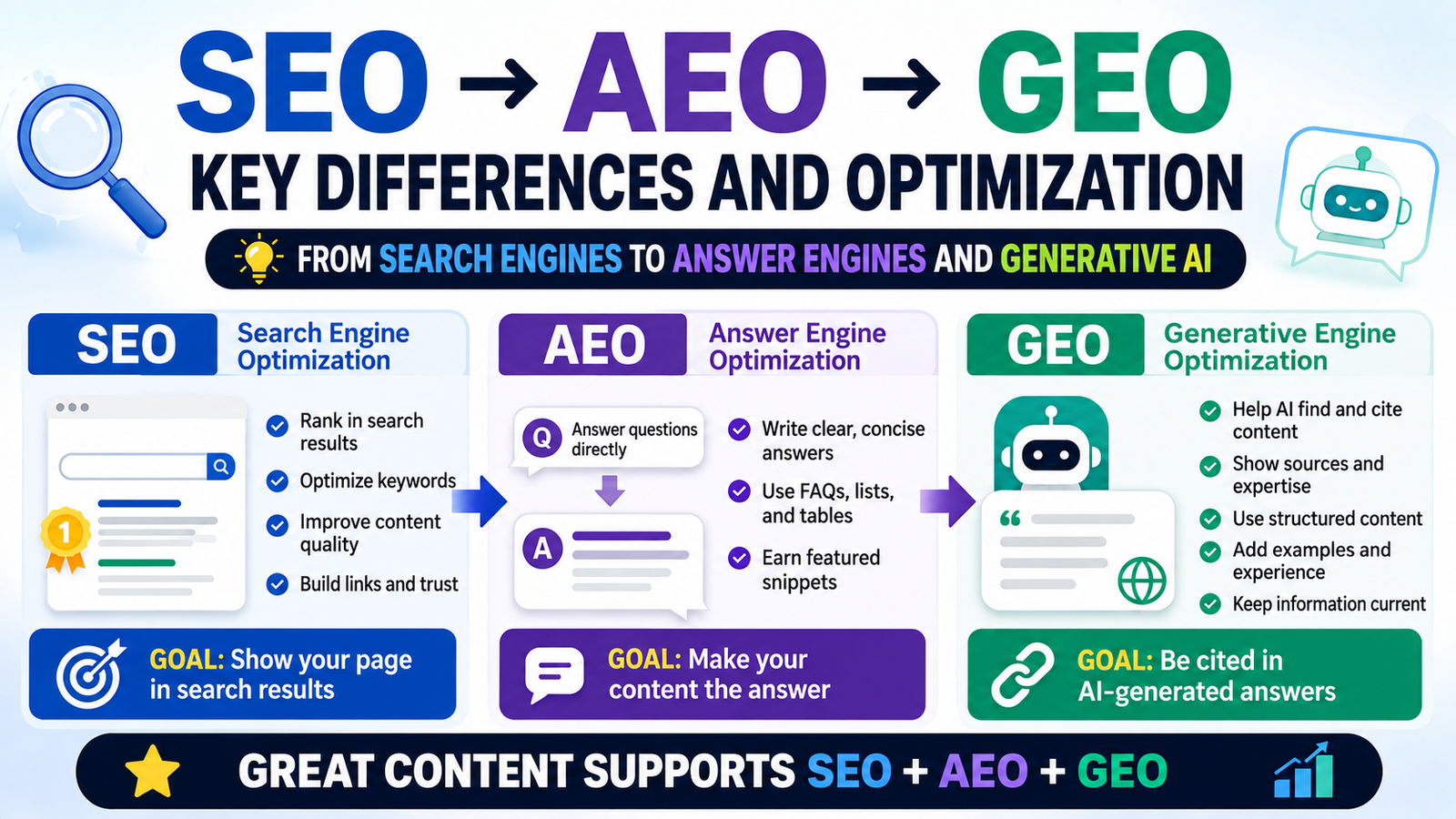
SEO, AEO, and GEO are complementary approaches to making content discoverable and useful. SEO helps a page appear in traditional search results, AEO helps systems extract a direct answer, and GEO helps generative AI understand, use, and potentially cite the content.
They are not three isolated techniques. Effective answer engine optimization (AEO) and generative engine optimization (GEO) still depend on the technical accessibility, relevance, structure, and trust signals associated with search engine optimization (SEO).
What is SEO?
SEO stands for search engine optimization. It is the practice of improving a website and its content so that a relevant page can be discovered and ranked by search engines such as Google and Bing.
Suppose you publish a guide titled:
How to Configure a Static IP Address on Rocky Linux
People may search for related phrases such as:
- Rocky Linux IP configuration
- Rocky Linux static IP
- Configure static IP on Rocky Linux
- Change Rocky Linux IP address
- Rocky Linux NetworkManager IP settings
SEO begins with understanding the intent behind those searches and creating a page that answers the underlying need. Its practical goal is to earn relevant visibility in search results and help the right reader choose the page.
Content that matches search intent
Repeating a keyword is less useful than identifying the result a reader actually needs. Someone searching for ?쐂isable SELinux on Rocky Linux??probably needs the commands, configuration steps, verification procedure, and security caveats before a long history of SELinux.
A clear title and heading structure
A logical outline helps readers, search engines, and AI systems understand the page:
H1: How to Disable SELinux on Rocky Linux
H2: Check the Current SELinux Status
H2: Temporarily Set SELinux to Permissive Mode
H2: Permanently Disable SELinux
H2: Verify the Configuration
H2: Risks of Disabling SELinux
Useful internal and external links
Internal links show how related pages fit together. A Rocky Linux site might connect installation, static IP, SSH, firewall, and SELinux guides. External links should point to authoritative sources when they help readers verify a command, policy, or specification.
What is AEO?
AEO stands for answer engine optimization. Its purpose is to make a page's answer easy for a search engine or AI system to identify and present directly.
For a question such as ?쏻hat is EDR??? a concise answer should appear before the expanded explanation:
Endpoint detection and response (EDR) is a security technology that continuously detects, investigates, and helps respond to threats on endpoints such as PCs and servers.
This question-first structure makes the answer useful even when it is extracted from the surrounding article. A practical pattern is:
Question ??direct answer ??supporting explanation, conditions, and examples
Lists, comparison tables, definitions, and genuine frequently asked questions can also help, provided they fit the information rather than being added merely for markup.
What is GEO?
GEO stands for generative engine optimization. It describes efforts to make content easy for generative AI services to find, understand, use as evidence, and?봶here the service supports it?봠ite as a source.
Generative systems may synthesize an answer from several documents rather than return one page as the result. A complete, well-supported article can therefore contribute evidence even when the user's final answer is generated by an AI service.
GEO does not mean adding a hidden ?쏛I keyword??layer. It emphasizes clear entities and terminology, verifiable claims, first-party evidence when available, explicit dates and conditions, logical structure, and a transparent distinction between fact and interpretation.
SEO vs. AEO vs. GEO: the key differences
The three approaches can be compared as follows:
| Category | SEO | AEO | GEO |
|---|---|---|---|
| Meaning | Search engine optimization | Answer engine optimization | Generative engine optimization |
| Primary context | Traditional search results | Direct answers and featured results | Generative AI answers |
| Goal | Relevant rankings and visits | Selection as a clear answer | Use as reliable evidence or a cited source |
| Core elements | Intent, technical access, content, links | Questions, direct answers, structured explanations | Trust, evidence, context, entities, structure |
| Measurement | Visibility, rankings, clicks, outcomes | Answer exposure and assisted outcomes | AI visibility and citations where measurable |
- SEO: helps a relevant page appear in search results.
- AEO: helps the content serve as a direct answer to a question.
- GEO: helps generative AI understand and support an answer with the content.
Does AEO or GEO make SEO obsolete?
No. SEO remains foundational because a system must be able to discover, access, interpret, and trust a page before it can reliably use the page as an answer source.
A practical content strategy considers SEO, AEO, and GEO together rather than treating them as separate checklists.
1. Put the real topic in the title
?쏦ow to Configure a Static IP Address on Rocky Linux??is more specific than ?쏷he Complete Guide to Server Networking.??The first title identifies the operating system, task, and expected result.
2. Answer the core question near the beginning
To configure a static IP address on Rocky Linux, use NetworkManager through nmcli or nmtui. On a server, nmcli lets you set the address, gateway, and DNS from the terminal.
Once the direct answer is clear, expand it with prerequisites, commands, examples, verification, and recovery steps.
3. Use headings that reflect real questions
- How do you check the current IP address on Rocky Linux?
- How do you set a static IP address?
- How do you configure the gateway?
- How do you set DNS servers?
- Do you need to restart the network connection?
These headings help readers navigate the article and map naturally to specific search and conversational queries.
4. Explain commands instead of listing them alone
ip addr
A useful explanation would add: ?쏳un ip addr to display the server's network interfaces and assigned IP addresses.??The sentence remains understandable when quoted outside the surrounding paragraph.
5. Match the format to the information
Use ordered steps for procedures, bullets for conditions or features, tables for meaningful comparisons, and FAQ pairs only for genuine follow-up questions. Structure should help people read the page first.
6. Add first-hand evidence and precise context
If you tested a procedure, name the relevant version, date, environment, method, and limitations. Specific evidence?봲uch as a verified Rocky Linux version or a reproducible failure condition?봧s more useful than a generic rewrite of another page. Do not present an unperformed test as personal experience.
7. Keep changeable information current
Software commands, product features, prices, and policies can become obsolete. Review affected pages when versions change, and separate the publication date from the date on which a claim or test was verified.
What should you measure?
Do not assume that applying these practices guarantees ranking, direct-answer placement, or citation in an AI response. Search and generative results vary by service, query, location, account, and time.
Measure traditional search visibility, clicks, engagement, and conversions where appropriate. For AI discovery, use platform-provided citation or referral data when available and compare multiple relevant query formulations over time. Treat third-party ?쏛I visibility scores??as estimates unless their methodology and coverage are clear.
Summary
SEO makes content discoverable, AEO makes an answer extractable, and GEO makes the supporting evidence easier for generative systems to interpret and cite. All three benefit from the same fundamentals: a real reader need, clear language, sound technical access, credible sources, original value, and regular maintenance.

SEO vs. AEO vs. GEO / Key Differences and How to Use Them
Compare SEO, answer engine optimization, and generative engine optimization, then learn how clear answers, credible evidence, and useful structure support all three.

Does Mass-Produced AI Content Hurt Search Rankings? Google and Bing Policies
AI-assisted content is not penalized simply because AI was used. Learn how Google and Bing treat scaled content, which publishing patterns create risk, and how to build a responsible review workflow.

How to Convert Images to WebP / PhotoScape X and Online Tools
Learn how to convert JPG and PNG images to WebP with PhotoScape X or a browser-based tool, choose a useful quality setting, and avoid common publishing problems.

Google Analytics / How to Exclude a Specific IP Address in GA4
Exclude your home, office, or development traffic from GA4 by defining internal IP addresses and testing an exclusion data filter before activation.