SEO vs. AEO vs. GEO / Key Differences and How to Use Them
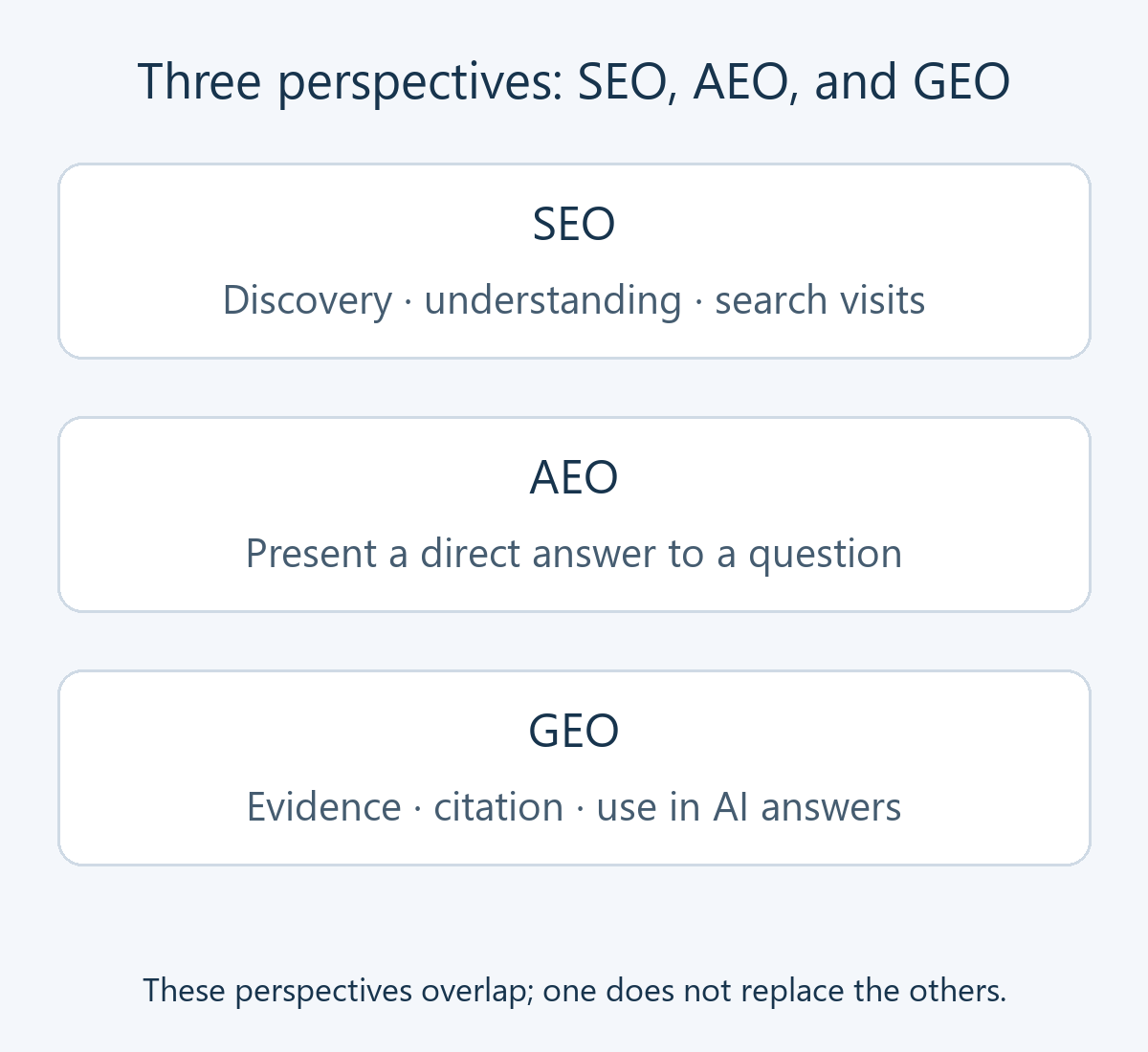
SEO improves how search engines discover and understand content and connect it with relevant readers. AEO focuses on answering a question directly, while GEO focuses on how content supports or is cited in generative AI answers. These perspectives overlap: they are not successive stages in which AEO replaces SEO and GEO replaces both.
How do SEO, AEO, and GEO differ?
The terms stand for search engine optimization, answer engine optimization, and generative engine optimization. AEO and GEO do not have identical boundaries across the industry, and search services do not necessarily provide a separate score or ranking for each label.
| Perspective | Question to ask | Work on a blog |
|---|---|---|
| SEO | Can the page be discovered, understood, and visited? | Check access, indexing, search intent, titles, useful content, links, and usability. |
| AEO | Does it answer the reader's question directly and sufficiently? | Give a clear answer, then explain conditions, evidence, and methods in an appropriate format. |
| GEO | Does it provide accurate evidence and context for a generated answer? | Include sources, scope and exceptions, original explanations, and verifiable examples. |
A WebP conversion guide needs to be discoverable, answer how to convert an image, and explain quality settings and tool differences accurately. Improve the same article from all three perspectives rather than publishing three near-duplicates for search engines, answer systems, and AI.
SEO involves more than placing keywords
The Google SEO Starter Guide describes helping search engines understand content and helping people find a site and decide whether to visit. A keyword in a title cannot resolve an inaccessible page or an article that fails to answer the question.
- Discovery and indexing: connect the page through relevant links and check that intended public content is not accidentally blocked. Submitting a sitemap does not guarantee indexing.
- Content and titles: deliver what the title promises. Provide definitions, selection criteria, and methods instead of repeating a phrase.
- Usability: check mobile tables and images and make sure advertising does not obscure explanations or controls.
A useful starting point is to check a post's indexing status in Search Console, then compare search queries with the page's actual coverage. A WordPress SEO plugin manages outputs such as titles and metadata; its score or preview cannot guarantee a ranking or click.
AEO does not mean keeping only a short answer
Start by identifying the actual question and answering it without a long introductory detour. Use a definition for a concept, ordered steps for a procedure, and explicit criteria for a comparison. A short answer becomes less useful if it omits conditions that change the result.
Consider “What WebP quality should I use?” Answering only “85” overlooks the difference between a photograph and a screenshot containing small text. A more useful answer is:
For photographs, a tool's quality setting of 80–85 can be a starting point for comparison. For small text or interface images, consider higher quality or lossless output and compare with the original at the intended display size. Quality numbers and results vary by tool and image.
Follow that answer with conversion steps and an actual file comparison so the reader can complete the task. This example illustrates a useful structure, not a word-count formula for search placement.
Featured snippets are often discussed under AEO, but Google says publishers cannot mark a page as a featured snippet: its systems make the selection. Adding a table or FAQ does not automatically create an answer box.
GEO needs evidence and explicit scope
GEO concerns how content is discovered, used as supporting evidence, and presented as a source in generated answers. A brand mention, a cited URL, and a visit to the site are different outcomes. An increase in one does not establish an increase in the others.
The GEO research paper measured visibility in experimental settings and reported that effectiveness varied across domains. Its experimental gains should not be presented as a guaranteed increase in blog visits or a result that applies to every AI service.
For a blog, separate verifiable facts from interpretation and use primary sources for changing prices, policies, and features. A practical guide needs prerequisites, concrete steps, expected results, and likely failure points. If you perform a test, state its environment, method, and relevant limits; do not invent personal experience.
For example, before stating that a free plugin stores email, identify the product, feature scope, and actual storage location. Likewise, distinguish a successful send operation from arrival in the recipient's inbox. Those details keep a quoted sentence from becoming misleading when removed from the surrounding article.
Are special AI files or settings required?
Google's guidance for generative AI search emphasizes established SEO and valuable content. An llms.txt file, special AI markup, artificially tiny sections, and near-duplicate pages for every query variation are not prerequisites for Google visibility. That statement about Google should not be expanded into a claim that every external service handles those files identically.
Content quality and participation settings are separate issues. Google states that its Search generative AI control became available worldwide on August 31, 2026. Check inclusion, exclusion, or inheritance under Search Console settings. The default is inclusion or inheritance; permission does not guarantee exposure, and this control is separate from AI training choices.
Search access and model training are also separate for ChatGPT. The official OpenAI crawler documentation distinguishes OAI-SearchBot for search from GPTBot for training and says their settings can be managed independently. See the ChatGPT search crawler checks for a more focused explanation.
How should you improve one article?
- Define the reader and question. “Convert a blog PNG to WebP and check its quality” gives a more actionable scope than “Everything about image optimization.” If an existing article already addresses the need, consider improving it before creating another.
- Answer early and explain thoroughly. Go beyond definitions to prerequisites, selection criteria, methods, and exceptions. Add headings and a table of contents where navigation helps.
- Verify examples and evidence. State calculation assumptions, relevant versions, countries, and policy limits. Add images when they explain a concept or step, with meaningful alternative text.
- Review links and the public page. Link to material the reader needs in that context. Check the actual mobile presentation of tables, images, and advertising.
- Record changes and observe separate outcomes. Track search clicks, AI exposure or citation, visits, and meaningful on-site actions rather than combining them into a single success claim.
The people-first content guidance provides a useful starting question: can readers solve their problem without needing another search? Repeating information to reach a target length does not make an explanation more complete.
How can you measure the results?
Use Search Console's search performance data for ordinary search results. The Generative AI performance report shows link impressions for AI Overviews and AI Mode by page, country, device, and date. Impressions are not visits or conversions, and insufficient data can prevent the report from appearing.
For supported Microsoft experiences, consult Bing Webmaster Tools AI Performance for citation and topic information. Its coverage does not represent every AI service. Use analytics separately for actual visits and on-site behavior.
Asking an AI a question once is only a supplementary observation. Wording, language, service, and timing can change the response, so record the questions and conditions and observe them repeatedly. Even if results rise after an edit, changing demand or search systems may contribute; timing alone does not prove that the edit caused the increase.