10 Major AI News Stories / September 21, 2026 ~ September 30, 2026
From September 21 through September 30, 2026, major AI announcements spanned new models, robotics tools, enterprise agents, privacy architecture, and scientific research. This article selects 10 developments rather than ranking every announcement from the period. Each item explains what was announced, whether it was available at the time, and what readers should be careful not to infer from the claims.
For the preceding period, see 10 Major AI News Stories / September 11–20, 2026.
OpenAI launches GPT-6 Sol and Luna — September 22
OpenAI expanded its GPT-6 family with Sol and Luna. The company positions them as faster, less expensive ways to use advances introduced with Astra. Sol targets more demanding work and coding, while Luna is designed for higher-volume, cost-sensitive tasks. At the time of the announcement, developers could use gpt-6-sol and gpt-6-luna through the API, and both models were rolling out in ChatGPT Work and Codex for Plus, Pro, Business, Enterprise, and Edu users. Free and Go users could access Luna in the desktop app. OpenAI explicitly said the models were not yet available in Chat.
The practical shift is toward choosing a model for the difficulty and economics of a task, rather than always using the most capable option. OpenAI's performance and cost comparisons come from specified evaluations, however. A production workflow also needs to account for tool calls, retries, human review, and the total cost of a successfully completed task. The six-model GPT-6 and GPT-5.6 comparison separates input, output, cached input, and reasoning considerations when evaluating those costs.
Source: OpenAI's GPT-6 Sol and Luna announcement
Anthropic introduces Claude Opus 5.5 — September 22
Anthropic introduced Opus 5.5 as the first model in the Claude 5.5 family. The company reports improvements over Opus 5 on complex coding and knowledge work, while estimating that typical workloads cost about 40% less to run. It also highlighted pre-release testing that included external evaluators and stronger safeguards for sensitive cybersecurity and biology tasks.
Teams delegating long-running work to agents should look at cost per completed task alongside quality and controls. The roughly 40% figure concerns typical task costs at default settings. It is not a uniform token-price discount: the announced input and output prices were 20% lower than Opus 5, while cache reads were 60% lower. The model was available on the Claude Platform, AWS, Google Cloud, and Azure at announcement. Before switching, organizations should test their own tasks for output quality, elapsed time, and the effect of safety restrictions.
Source: Anthropic's Claude Opus 5.5 announcement
NVIDIA brings agent-ready tools to Isaac ROS 5.0 — September 22
NVIDIA unveiled Isaac ROS 5.0 at ROSCon. The Robot Operating System (ROS) is an open-source framework for building robotics applications. The release adds agent-ready documentation and reusable skills intended to help developers automate robotics-development tasks. It also supports ROS Lyrical and Ubuntu 24.04 and expands perception and inference components for robots running on NVIDIA Jetson hardware.
This does not mean an AI agent can safely operate a robot without further engineering. The notable change is that tools for building and deploying robotics software are becoming more accessible to development agents. Real-world safety and performance still require testing with the specific sensors, hardware, environment, and validation process involved.
Source: NVIDIA's Isaac ROS 5.0 announcement
Anthropic reports an enzyme system identified with Claude — September 23
Anthropic's life-sciences team reported that Claude agents examined a large DNA-sequence dataset and identified a previously uncharacterized enzyme system associated with repeating sequences. The researchers call it an array-associated reverse transcriptase (ART) system. The underlying reverse transcriptase had been identified in earlier research; the reported discovery connected it with a repeat array and an accessory protein to characterize the system. Claude agents searched and analyzed candidates, while human scientists performed the laboratory work.
The interesting step is from summarizing existing research to generating a candidate that can be investigated experimentally. The team says ART's main function is still unknown. A repeat pattern reminiscent of CRISPR does not establish that ART is a new gene-editing tool or that it has medical applications. The findings are early-stage research shared in a preprint.
Source: Anthropic's enzyme-system research announcement
Google DeepMind details private, server-side AI memory — September 23
Google DeepMind described a server-side memory design for Private AI Compute. It is intended to let an assistant retain useful context across devices while keeping the keys needed to decrypt stored information on a person's own devices. Requests would use encrypted connections to an isolated computing environment. Google also released technical documentation, a public record intended to make server-software tampering detectable, and results of an independent security audit.
The proposed change extends a stateless system, which clears context after a task, with storage that can retain encrypted context between requests. The diagram separates the roles of the device, isolated processing environment, and storage. It illustrates the announced design, rather than a product screen or a security test performed for this article.
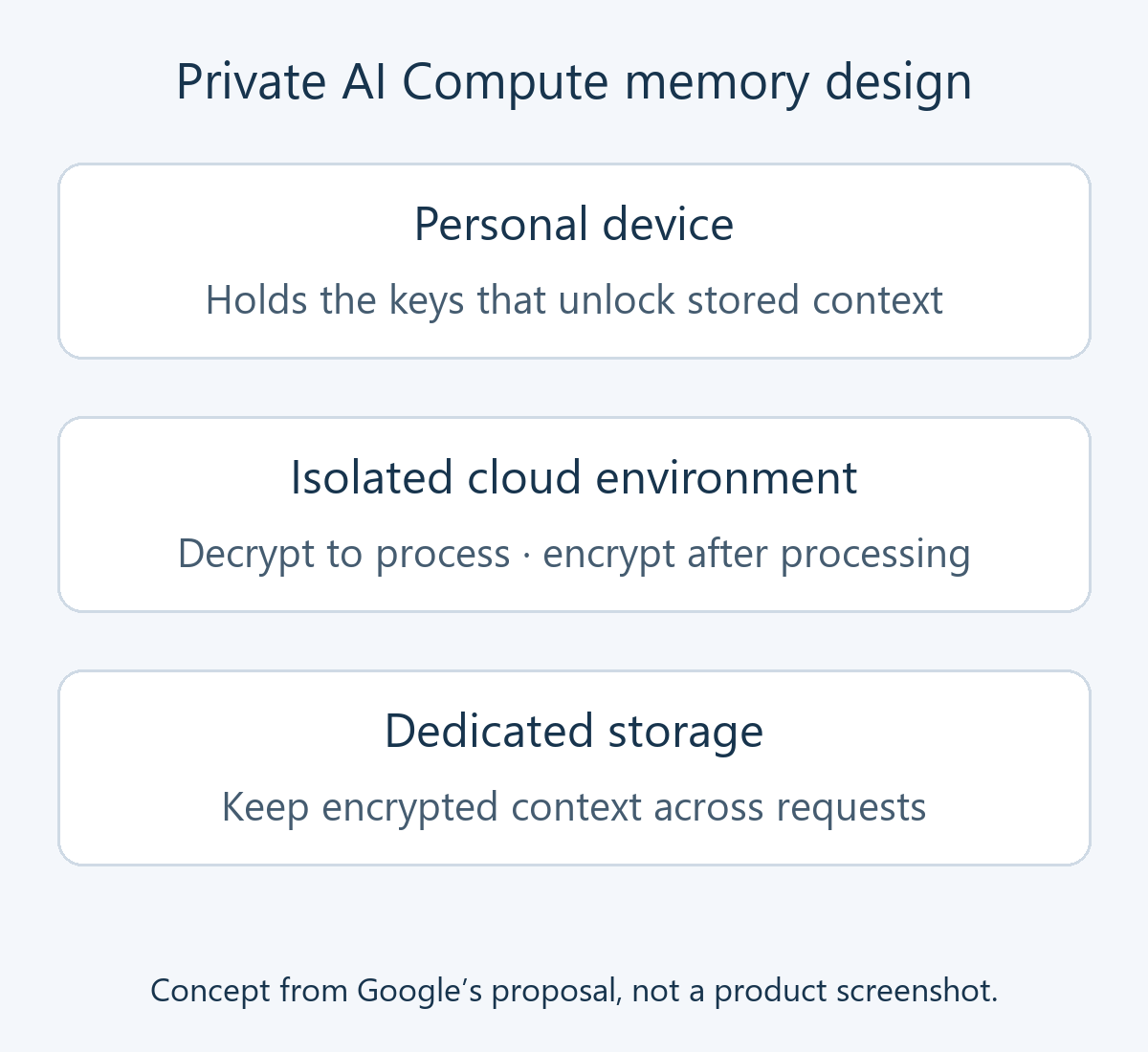
Persistent memory could make assistants more useful, but it also raises questions about who can access stored context and how it is protected. This announcement describes an architecture and ways to verify it; it does not mean long-term memory is already enabled in every Google product. Actual availability and user controls need to be checked for each service.
Source: Google DeepMind's Private AI Compute technical update
Google introduces Gemini 3.8 Live with Live Avatar — September 24
Google introduced Gemini 3.8 Live with Live Avatar, which combines spoken conversation with near-real-time video of an AI avatar. According to the company, it processes audio and visual input together and can call tools in the background while continuing a conversation. Google pointed to enterprise uses such as customer service and interactive guidance.
The feature was available in Gemini Enterprise at announcement, but creating a custom avatar required separate enterprise allowlisting. As AI-generated faces and voices become more natural, clear notice that users are interacting with AI, identity protection, and consent become more important. Google says it applies SynthID watermarking to generated output.
Source: Google's Gemini Live Avatar announcement
Microsoft unveils Copilot Home, Code, and Autopilot — September 25
Microsoft announced a new Copilot experience organized around Home, Code, and Autopilot. Home brings conversational and delegated work into one starting point. Code aims to let people create business apps, dashboards, and automations from natural-language instructions. Autopilot was presented as an agent that can continue follow-up work within a defined role, goal, and set of permissions.
For organizations, the central questions are who grants access, what company data an agent can use, how actions are audited, and how usage is billed. At the announcement, Home and Code were scheduled to roll out through the Frontier program, while Autopilot was due to expand its private preview at the end of the month. These were not all immediately available to every Microsoft 365 customer.
Source: Microsoft's new Copilot announcement
Meta announces an enterprise AI platform — September 28
Meta announced Meta Enterprise Platform as a new business focused on AI for organizations and developers. It said its initial focus would be bringing technologies including the Muse agent, Meta Business Agent, Muse API, and Muse Code into enterprise products. The company also named a leader for the new platform.
This is best read as a strategic move into enterprise AI, beyond Meta's consumer products and advertising tools. It does not by itself establish release dates, pricing, regional support, or adoption results for every component. Potential customers will need to examine the eventual product-level security terms, data practices, and integrations with existing systems.
Source: Meta's Enterprise Platform announcement
Anthropic releases Claude Sonnet 5.5 — September 28
Anthropic followed Opus 5.5 with Sonnet 5.5. It describes Sonnet as a fit for well-scoped everyday tasks, bug fixes, and creating documents, slides, and spreadsheets. The company says output generation is more than 30% faster than Sonnet 5 and most tasks cost up to 30% less. In its product lineup, Opus is intended for more complex judgment, while Sonnet emphasizes faster iteration.
Standard input and output prices remained the same as Sonnet 5 at $2 and $10 per million tokens, with cache reads at $0.10. The task-cost savings include needing fewer tokens to finish work; they are not a 30% discount on every rate. At launch, Sonnet 5.5 was available on the Claude Platform, AWS, Google Cloud, and Azure. Anthropic's benchmark results and savings estimates depend on its stated evaluation and workload assumptions; they will not carry over unchanged to every use case.
Source: Anthropic's Claude Sonnet 5.5 announcement
OpenAI introduces GPT-6.1 Sol — September 29
One week after launching GPT-6 Sol, OpenAI introduced GPT-6.1 Sol. The company says it approaches its higher-end Astra model on selected agentic coding, computer-use, and professional-work evaluations at a lower standard API token price. The one-fifth comparison with Astra describes standard input and output rates, not a guarantee that every finished task costs one fifth as much or takes one fifth as long. At announcement, it was available through the OpenAI API and to eligible paid-plan users in ChatGPT Work and Codex; OpenAI said it was not yet available in Chat.
The quick follow-up illustrates how competition is shifting toward how much useful work a model can complete for a given budget. “Near Astra” refers to the evaluations OpenAI reported, not every possible task. Developers should compare success rates, retries, review time, and total cost in their own tool-connected workflows. The GPT-6.1 Sol introduction explains its access routes and pricing in more detail.
Source: OpenAI's GPT-6.1 Sol announcement
What connects these 10 stories?
Three themes run through this period. New models compete on speed and cost per task as well as peak capability. Agents are moving beyond document work into robotics development and enterprise workflows. And as assistants gain persistent memory, scientific roles, and humanlike avatars, privacy, validation, and safety controls become more consequential.
To decide what matters for your work, identify the type of announcement first. A released model calls for checking access and costs; a preview calls for checking eligible accounts and permissions; research calls for separating experiments from proposed applications. An architecture proposal or business strategy does not automatically constitute a finished product you can deploy.
| What you are evaluating | Conditions to check | Question before adoption |
|---|---|---|
| New models | App or API access, plans, token rates versus task-cost estimates. | With the same inputs and completion criteria, what happens when rework is included? |
| Enterprise agents and avatars | General availability versus previews or allowlisting; data access and action permissions. | Who approves actions, and how are records and error recovery checked? |
| Science and security designs | Experiments versus proposals, unknown functions, and actual product deployment. | Which findings are established, and which applications remain possibilities? |